Two Months in a Psychiatric Hospital
Bureaucrat With a Face
In 1973 to legally drive your car you needed a tax disc which you stuck on the inside of the windscreen on the passengers side. They could be issued for the full year, or for quarter of the year. With the correct paperwork – MOT and correct insurance – you could do this at any Post Office. Or, if you lived in London, you could go to one of the four GLC (Greater London Council) Vehicle Licensing Offices spread across the city. I briefly worked in the east London one.

East London GLC Vehicle Licensing Clerical Officers on a lunch break.
Conservative Edward Heath was the Prime Minister. Slade were going to top the charts that 1973 Christmas with Merry Christmas Everyone. And the latest incentive to drink in crowded, manky cigarette smoke filled East End pubs was a bra-less girl on a table wearing a tight white wet t-shirt making moves to T Rex.’s Get it On. Her mate, smoking a Players No.6, held her handbag and parka during the ‘show’. And on BCC TV’s popular Top of the Pops regular presenter DJ Jimmy Saville felt-up under age girls in his BBC make-up room. “Now, now then, ha ha, boys and girls”. In reality it was ‘now, now girls….’
. . . . . . . . . . . . . . . . . . . . . . . . . . . . .
I’d been working for East Ham council Parks Department, and for reasons I’ve forgotten, I was on the dole. Leaving school in 1963 I laboured on building sites, Council Parks Departments, the Forestry Commission and ended up as a self-employed jobbing gardener on Arran. But there was no scope for jobbing gardeners in East London.
1973 was when African dictator Idi Ami was expelling Asians from Uganda. He announced the expulsion in August 1972. It began in November 1972. Many had British Passports. They were still arriving in Britain well into 1973. The Stratford Labour Exchange in east London was crowded with Asian families from Uganda. West Indians and local white folk exchanged knowing – almost conspiratorial looks with each other – as they glanced at them.
Signing on at the Stratford Labour Exchange the clerk at the counter noticed I had 5 O Levels. ‘Ah, I see you have five O levels, including English – there’s a job here for you – Vehicle Licensing – Just down the road.” Anyone who has signed on knows: be careful turning down a job – turn too many down without a good reason and you won’t get your unemployment benefit. ‘I’ve never done inside work..’ – ‘Oh, there’s nothing to it.’ – “What’s the pay”. It was about the same as I had been getting working as a garden labourer in the Parks Dept. “It’s got prospects; stick with it, show you can do it, keep your nose clean and you will rise up the CO scales” – “CO?” – “Clerical Officer”. “Oh.” “And you might even make it to an EO if you keep your nose clean” ‘EO?” – “Executive Officer. Then you’re talking. Job for life”.
The Vehicle Licensing office may have been ‘just down the road’ but I was having to walk it, and it was starting to piss down.
The Vehicle Licensing Office was further up the road, just before you get to the Bow Flyover. The road, the busy A118, was hissing with wet traffic. As I got almost to the 1960s multi-story offices there was this appalling smell, worse than anything the average human being would smell in their lifetime. I was soon to learn that it came from a glue factory, up a side road next to the Vehicle Licensing Office. The glue factory was daily fed by open-top lorry loads of ‘waste’ from an abattoir. Tipper lorries, open tops, no tarpaulins, rib cages sticking out from a shifting, red glutinous mess, that had once been – “Ooh look Mummy, Mummy cow and baby cow”…. from a Ladybird book, or an I Spy book.
On the ground floor of the multi-story office building I showed someone my letter from the Labour Exchange. They pointed me to a door which opened onto a massive open office space. Desks and desks and desks. At the far end was a sort of flat roofed shed with its’ own door. I was to walk down to that and knock on the door …..
“I don’t mind my male staff having long hair, Mr Grafton,” said the E.O. (Executive Officer), in his lone, lonely office, “but I do insist on Male staff wearing a tie.” He says this as he files away the letter from the Labour Exchange.
He talks in a strangled, clipped voice, and looked like Philip Larkin, who was a North of England University poet, whose contribution to poetry was Your Parents Fuck You Up. (Just as well he never became a parent…)
The office, the hall, was split equally between the desks of manual workers – all ladies – who opened incoming postal vehicle licence applications, and on the other side of the hall, the desks of “COs” – the Clerical Officers who checked that the paperwork for the vehicle licence was enclosed. Paperwork: MoT, insurance, etc, and a postal order or cheque.
There was a divide between the ladies who opened the vehicle licence applications and those – the CO men and women – who scrutinised the enclosed paperwork. The ladies were more or less hire and fire, but the ‘scrutinisers’ if they kept their nose clean had a job for life . And they did keep their nose clean and strongly identified with what they saw as their class position: lower middle class.
One of the letter-opening ladies was quite a force, quite a talent. I’ll call her Wilma.
Her talent- almost like a comic music hall turn – was of talking non-stop with a fag permanently stuck between her lips, moving left/right, up /down, depending on the vowel or consonant she was using as she whittered on about her sore back, the unpleasant “he never-stops-talking” neighbour next door, and “that Tom cat of his” and other irritants of her life. The extraordinary thing was, you never saw the lengthening ash fall from her cigarette, despite it doing high-jumps, long-jumps and sideways jumps, as it followed the movement of her mouth.
She also had the knack, when the end of the working day bell went, of being the first one out the office. (The COs were too conscious of their class status to be part of something so vulgar as a mass stampede). So she’d be the first one to get to the bus stop. Should the No.25 pull up she’d elbow anyone out the way if they were unlucky enough to have got there first.
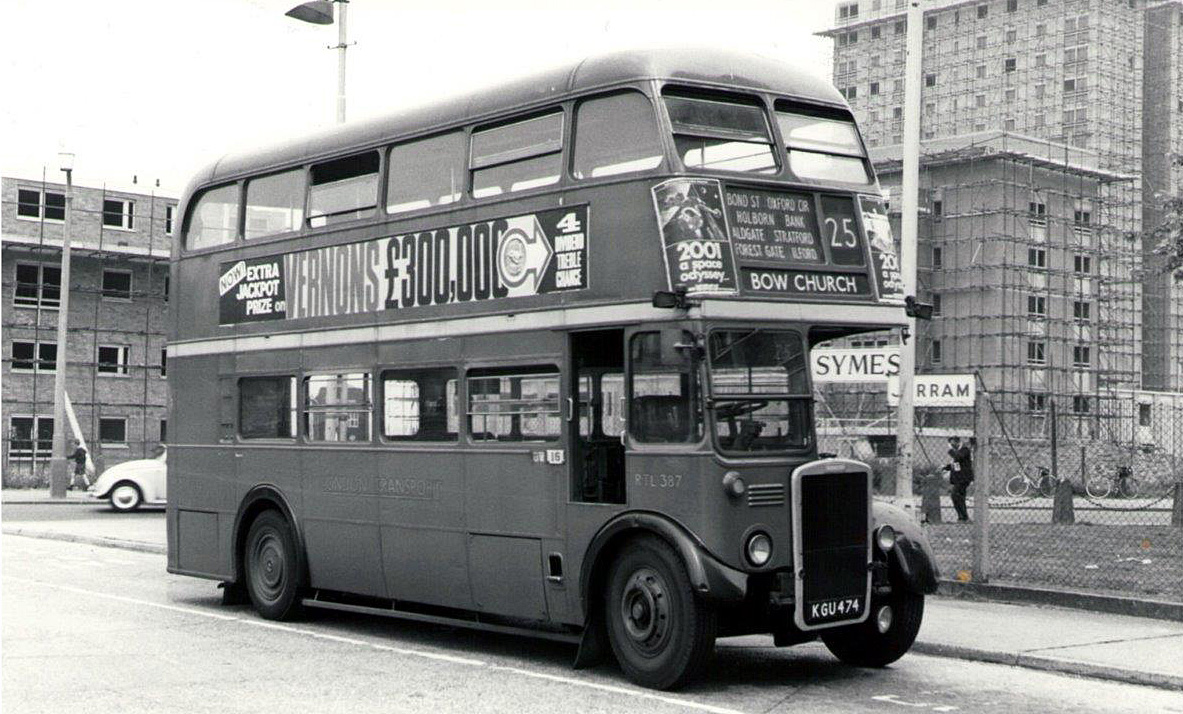
London Transport No. 25 Bus.
: : : : : : : : : : : : : : : : : : : : : : : : : : : : : :
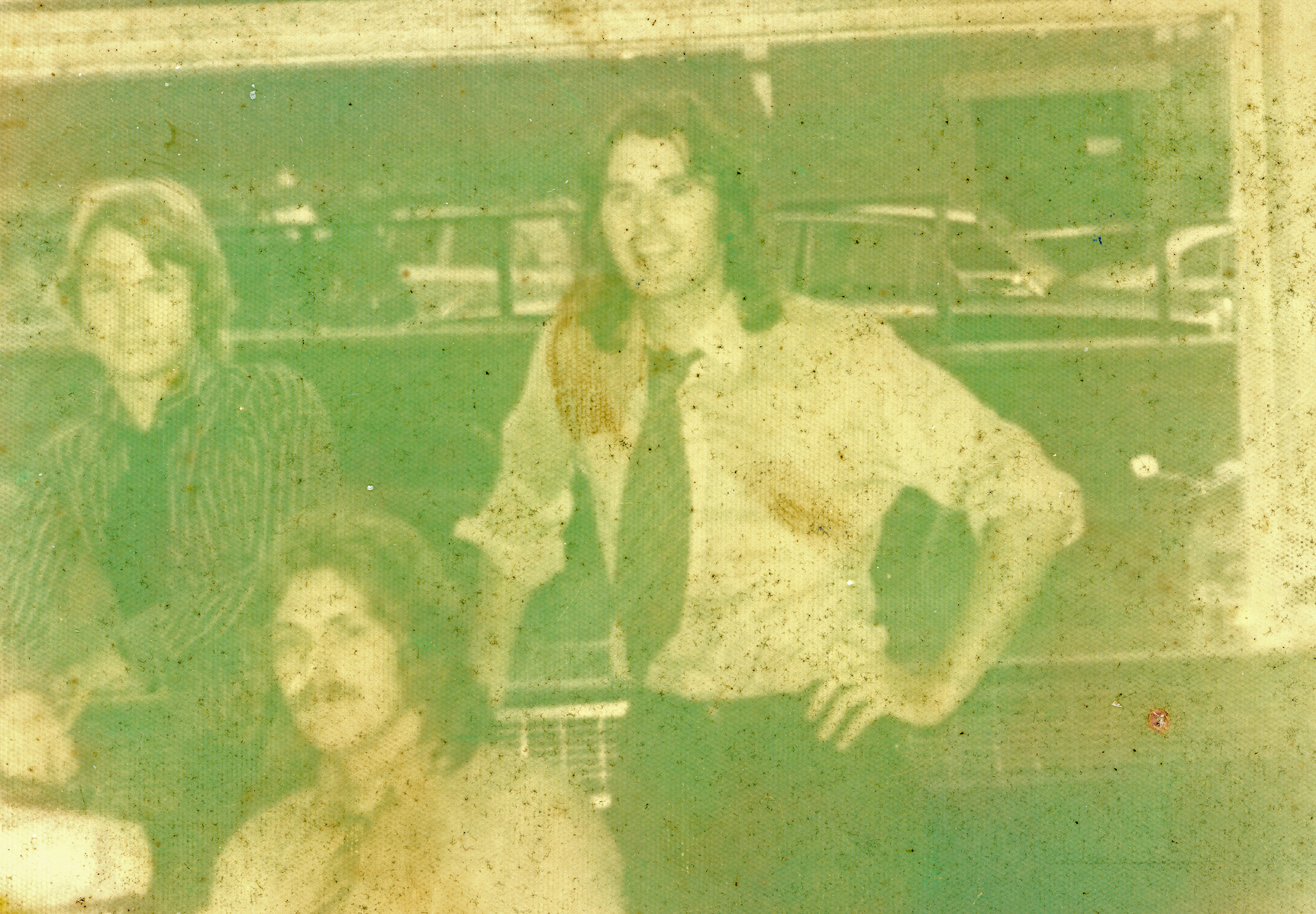
Vehicle Licence Clerical Officers. Behind them the lane up to the Glue factory. Being a modern building the double glazing protected them from the appalling wretching smell.
Down the left side of the open plan office were the desks of the Clerical Officers, whose job was to check the content of the postal vehicle licence envelopes; that everything that should be there was there before a licence was issued.
I was assigned to CO “Application Checkers”. Rows of communal, untidy desks, staffed by about about 70% women, 30% men, with a sprinkling of married CO couples amongst them.
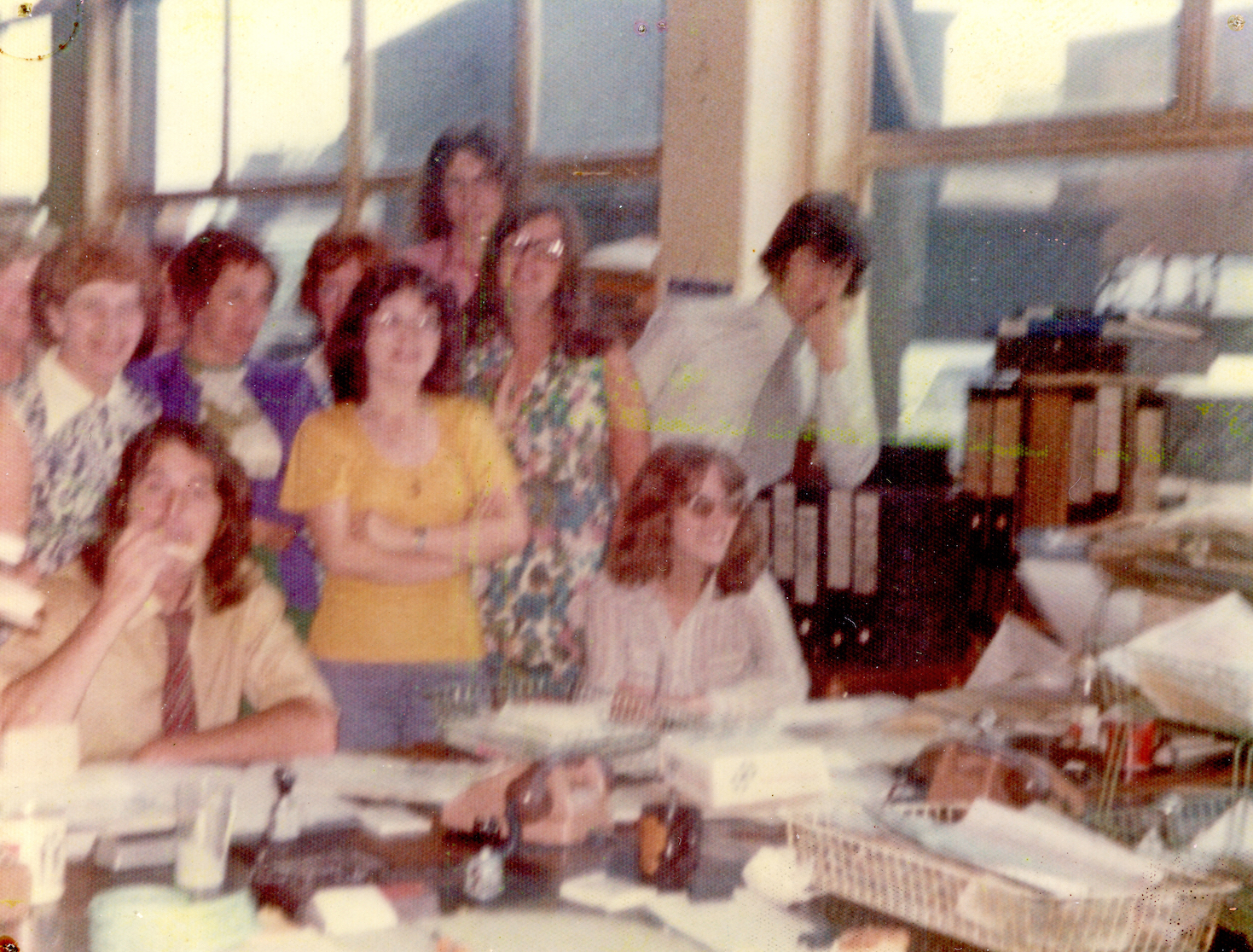
Vehicle Licensing Clerical Officers, including a female Senior One.
The daily job … Check the Insurance Cover, the actual cover, not the Reminder Note; Check the MOT. Check the MOT serial number against the list of stolen blank MOT certificates. Query any MOT if it doesn’t look right. Ring up the issuing garage or the car dealer, if there is a question mark. Lastly, check the enclosed postal order or cheque: Is it signed? Is it the right amount? Is it dated?
On the desks we had telephones to follow up any doubts – to issuing MOT garages mostly. Our phones (ex-directory) would also occasionally ring in to make an alleged ‘in-house’ enquiry. It might be someone claiming to be a Vehicle Licensing Issuing Officer in South London, or a copper from Fulham Road Police Station. Usually it was along along the lines of “We’re trying to trace the owner of Tam 158 vehicle reg”. Direct calls like this were suspect. The guidance for responding was: “Ah, right. If you give us your phone number we’ll get back to you.” Dead the line would hurriedly go. Or you might say “Send your enquiry on headed office paper.” Likewise, the line went dead. You’d get the brassed neck ones, who’d persist but they soon get worn down and hung up. Some would even said ‘Goodbye” in the local colourful patois: “Fuck you. Fuck you, you fucking c- -t! “.
Us Application Checkers were also rota-ed for the Counter Vehicle License Applicants. The long counter was screened off from our office, but was part of it. Beyond the screen, which reached the high ceiling of our unseen office, were queues of waiting applicants in the hall. Those who had traveled in their motors to the Vehicle Licensing Office had to risk getting a Parking Ticket, as there was no public parking near the office, and surrounding side roads had double yellow lines, including the one up to the Glue Factory. Knowing this, Traffic Wardens would keep out of sight, round a corner, and then, watching the departing owners heading to the Tax Office to licence their cars, move out swiftly, and blitzkrieg the parked cars windscreens with Parking Infringement notices, then retire to a caff for half an hour or so, until their next blitzkrieg
In-person applicants for Vehicle Licenses stood in lines stretching back from the ceiling reaching glass fronted counter, the hall behind them like a Passport Control area. We, the checkers, sat on high stools, so that we were psychologically higher, looking down on them. There was an inch or so gap at the bottom of the glass, that the applicants pushed through their Application, Insurance, MOT, etc. Unknown to them, each Vehicle Licensing Officer had a concealed Emergency button beneath his section of the counter. This was for any “Customer” who got a touch too verbal when you pointed out that it was an Insurance Reminder piece of paper, not the actual Insurance cover document and therefore the Licence couldn’t be issued. ‘What! I’ve come half way across London.. How do you mean it’s not the actual Insurance Cover?.. Well, it’s what my husband gave me.” The way some people crumpled, almost looking for a lifebelt in a stormy sea, as their shoulders sagged, I could believe them. But as Phil, a fellow worker put it to me, even if they weren’t “at it”, issuing a licence could drop them in it, if they were in an accident, where someone was injured or another car was damaged, they could end up in Court. For staff who were not transitory workers – as I was – they had mapped out their working career as a Vehicle Licensing Officer. To get a decent, secure Civil Service Pension when they retire they’d do nothing that would jeopardise making their way up the CO pole. There was no such thing as ‘Customer Care’. After all, Vehicle Tax Applicants were the potential enemy.
Concealed emergency buzzers were linked to the local Police Station. They were fitted underneath the counter. You – unseen – pressed the buzzer when a customer got very aggressive, and started fisting the shatter proof glass, declining the invitation to step to one side so the Applicant behind them could be served, as he continued to shout “I’ll fucking do you!! You fucking, etc, etc..”
If you – the Vehicle Licensing Officer – had accidentally set the Alarm off (not heard in the building) with your knee – by swinging off your stool for your lunch break and touching it – you had to quickly ring the Cop Shop : “False alarm.”
:::::::::::::::::::::::::::::::::::::::::::::::::::::::::::::::::
Us Vehicle Application Checkers were a varied lot.
A few were itinerant, like myself. The bulk were in it for the duration until they retired, working up the CO grades and getting a Pension. They were united by the belief in doing things the proper way, until their whole existence was – like a Nun – devoted to one cause. People in Inland Revenue are the same. I was going to say that they have no small talk, but that’s not true
Barbara was from south Yorkshire and had the accent to go with it. She would share with us descriptions of the Americans who lived next door to her and her husband… “And mess! You’ve never seen owt like it. You’d go in and kick your way through empty bottles – ” – “They like living it up, don’t they” said quiet Eileen, interjecting, as Barbara continued her saga of her American neighbours. Other items from Barbara included the woman who threw herself off the 17th floor of the building where Barbara worked, in Yorkshire… “She weren’t half a mess, I can tell you. I’ve never seen owt like it. It was reckoned she had a grudge against the Gas Board”. Then there was the Nurse who told her about how many incurable patients got bumped off in hospitals. Oh, yes – Incurable cancer patient cases; or people in oxygen tents – turning the oxygen off; or, just not feeding people. – “It goes on all the time.”
Then there is David, who is two years younger than me, and looks seven years older. He works at the same desk as his wife. He identifies totally with his job and the “office”. He mentions, significantly, that he and his wife are going to a “Show”. – “No, the Show – the original – not the film.” I didn’t catch what it was. Jesus Christ Superstar?
Then we have Vi, who is concerned – (besides other things such as how the Section should be run) – with how on an outgoing envelope people should be correctly titled. ie Ms, Miss, Mrs, Mr, Esq, etc. I got put right by her, unofficially, after I had been sending out envelopes with first name and surname only, which she had noticed. She wasn’t sure whether this was acceptable or not, but didn’t want to raise it with the EO Head of the Office, in case, I sensed, she got a black mark put into her file. Black mark because she had over-stepped the mark and her advice was not backed up by an Official Directive.
Official Directives: Forms circulated almost every day with, for instance, reference to taxing certain vehicles ie. Fire Engines. The Circular set out the proper set procedure for establishing that the vehicle was a Fire Engine. The forms were couched in a suffocating dead language – though on second thoughts, it’s not so true to say it’s dead – it’s more likely to kill the user – the language itself is horribly alive. We even got bits of paper telling us to save paper.
………….
Because of his independent nature Phil stood out.

Phil was different
He and his wife, both working class, had both gone to Plaistow Grammar and got their A Levels. Phil, I sensed, didn’t have a particularly happy home life, but the friends he and his wife had in the Sixth Form “Were a great bunch. We were all mates together”.
He’s now in his fourth office job, with a responsible position: handling Trade Plates, with his own files. He’s been with the GLC less than a year. He has a gift for the gab and if asked a straight question by a superior- the Office EO – gives a straight answer, rather than cow-towing or back-tracking. True example: EO “You don’t think I’d hold a grudge?” – Phil: “Yes I do”. (Grovelling to a Superior Officer is an Occupational hazard: Keep your Head Down and Keep your Nose Clean is your job mantra)
At some point Phil had been a skinhead, which was how he got into Ska, or was it the other way around? But there were turf wars between the skinheads, which got nasty with knives and bottles. He found himself in Canning Town one time where it was a situation he was going to have to “do” a bloke before “he done me”. And he thought “This is fucking ridiculous”. His hair has grown since then. He still loves ska but is now also into Soul and Funk .
He says the job is convenient both because it is near the flat, and the local Poly where is doing a five year evening course – BA in Business Studies. He eventually aims to work for himself – for the “Good things in Life”, as he puts it. He’s been, and his wife, through a very rough patch – “It wasn’t anything like we were led to expect at school – it was totally different”. That getting ‘O’ and ‘A’ levels could do wonders for them. The background is that the Borough, even by the early 1970s, had hardly managed to educate a child to the stage that they could get into a University. In fact, Bob, who also worked in the Section, and was younger than me, was the first ever child from Forest Gate to get to a university – Exeter, where he studied Economics.
The disappointment may be down to Phil and his wife being from a working class background in a working class London Borough, believing “O’ and “A levels” would open doors to a brighter future, a future of choices. As he repeated “It wasn’t like anything we expected”. Amongst many things, he singled out the problem of finding somewhere to live as one of the worst things, and said it was “wrong” that because “someone owned two rooms they could make a profit.” He said that at times – even at the moment, the only thing that makes it worthwhile is the baby – “great little thing” – and their marriage. His wife works in a Bank in the City, getting about the same as he does, £30 a week. Both are saving in a Building Society.
Apart from the local Vehicle Licence Application letter openers, and Phil and Bob, most of the CO Vehicle Licence checkers came from outside the Borough, places that had “posher” areas such as Gants Hill, East Ham, Hornchurch ….
:::::::::::::::::::::::::::::::::::::::::::::::
It’s strange and interesting becoming a “bureaucrat” with a face (as opposed to a faceless bureaucrat), particularly for me – someone who in general has been antagonistic to Labour Exchange, SS and other local council and government clerks. When you reach that glass barrier in their office, you bring a whole set of feelings: fears and prejudices when confronting that official behind the glass. Whereas, in a different setting, in a shop, or down the pub, these set of feelings wouldn’t be there. The answer is, of course, a bureaucrat is either going to accept your application, or reject it. You don’t have to fill in a form to get your shopping, or order a pint.
So I’m not in the pub, or a bloke in the street -I’m a figure of power. So here they are, confronting me, this Figure of Power who can say ‘Yeay’ or ‘Nay”. And they treat me accordingly. Either with a kind of cringing humility, or with a false nervous bonhomie, or a flagged up look of potential aggression, eyes narrowed. They wait as you check their documents. The slightest pause at looking at an item, or worse, a frown, and their pulse rate will shoot up. In the process – you yourself – also react differently. You can’t totally identify, or be matey with them. You both to a certain extent behave specifically – peculiar to the situation – what each one represents to the other. However, with one or two exceptions, as far as your Vehicle Licensing Officer’s concerned, you’re dealing with a potential enemy, someone who is potentially ‘at it’. Phil had mentioned to me a VLO who had been on Trade Plates, prior to him, and would get up at 3 in the morning, due to a sore throat, to get a glass of water, would look out the window, see a parked lorry with Trade Plates , write the red registration number down and check up on the them when he got into the office first thing in the morning.
The late months of 1973 – due to conflict in the oil-rich Middle East – was the time of Fuel Rationing and the Three Day Week.
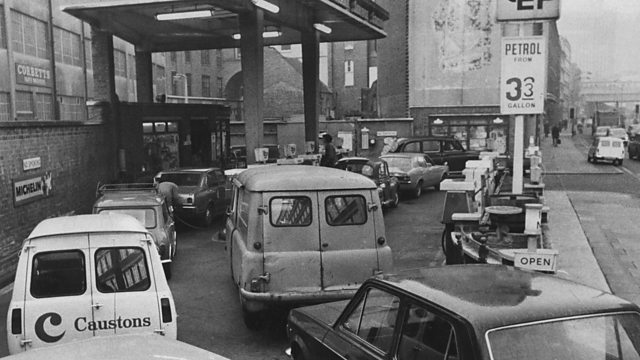
Queuing up for petrol and diesel, 3 day week, 1973.
At the end of November 1973 Petrol Coupons were issued by the Government on production of the correct paper work for your motor. Our Office, like other Offices, was jam-packed with folk requesting these Coupons. Quite a few of these Coupons applicants were people getting a Tax Disc. They’d been running their cars/vans around without any tax. ‘Repairs in Garage’ was the usual reason put on their the Tax Disc application form. To get the Fuel Coupons they needed to produce not only their Driving Licence but also the Tax Disc to get their ration of coupons.
::::::::::::::::::::::::::::::::::::::::::::::::
So here’s the rub: Government and Local Government clerks may be bureaucrats without a face, but with a UK population of 67 million people (2022 figures) people, with State Statutory obligations for Old Age Pensions, Housing Benefit, Unemployment Benefit, Sickness Benefit, Winter Heating supplements, and so on, it’s necessary that they are issued correctly; that the Bureaucracy is not inept, or prone to favouritism or corruption. As it is, Britain does not make the European Top Ten of least “Government/Local government Corrupt” countries. At present (2025) Denmark is the cleanest. The UK is at no. 12.
Tours and the Loire 1912

Tours and the Loire, 1912 photos
A French Summer in the Loire, 1912. A comfortably off French family, with employee; photos of Tours; of the Loire; of a horse and cattle-market. A car. A Loire mill. And cars racing.

19th century France meets the 20th Century: motorbikes and cars. The human voice and the way we look, and our world looks, is being recorded for the first time in history: movies and the Kodak folding camera, and the gramophone are signs of a change that will accelerate through the 20s and 30s. But women in the French Republic will have to wait until 1945 before they get the right to vote. And in 1912 film director Jaques Tati is five years old and photographer Jaques Henri Lartigue is eighteen years old.


Now on Pete Grafton/You Tube. Click below.
Corbières: Sex, Wine & Politics
Corbières

Sex, Wine & Politics

Sex
1973. Thezan – Saturday Night Entertainment. It was supposed to be a dance – put it this way, it was described as a dance. Juan and me roll up in his 1959 Swiss registered Peugot. Some local lads – average age 15 to 17 – are hanging around the open door to the village hall. Is anything happening? The doors open into a darkness. But we hear music. Ah, so there must be a dance. We get out and enter the hall. This is what we saw.
Only the stage is lit. On it, on the extreme right-hand side is a table and four chairs, a record player on the table and three blokes and two girls, all smoking in a meaningful ‘sophisticated’ way – particularly the girls – one of whom flirts with the bloke putting the records on. And really weird records they are too, totally nondescript. The only tune I recognise is Sunny, sung in French. The volume, turned up to maximum, is not enough to fill the hall, and is distorted.
The girl who flirts wears a white sweater and trousers and has her hair short. The general style of clothes – boys and girls – is from ten years ago, or even more. Or maybe it’s timeless.
The girl who flirts strides around the stage, jumps off and back on it. She’s familiar with it, and the hall. She does this with a sort of contempt for the audience – yes, audience. For instead of clearing the hall chairs to the side, for dancing, they remain in place. There is hardly anyone dancing. A lot of the seats are occupied by young itinerant Spanish men in their twenties. Grape pickers, from across the border. They nudge each other when a girl or woman walks past, or enters the hall. Older Spanish men are also seated together, quietly smoking. Also some Spanish Mum’s, Dad’s, daughters and sons are sitting together. All grape pickers. There is just a sprinkling of local teens, some of whom are siting at the back of the hall in the near dark, but no necking is going on.
Meanwhile the flirting on the stage continues, leading to the ‘D.J.’, who looks as if he’s in his early 20s, chasing the girl up and down the short aisle between the chairs, until, eventually, at the back of the hall they catch one another and embrace steadily for 5 minutes, watched by 75% of the ‘audience’, mostly the Spanish men, whose steady gaze falls on their entwined bodies. Coupled with this burst of activity, suddenly up front, near the stage one boy and girl and one girl and one girl are dancing to the strange and distorted music. They’re dancing a sort of jogging foxtrot, and these are kids in their teens. Their hands demurely not touching each others bodies, except for a hand on a shoulder, or, as horny as you dare get, lightly the waist.
One of the other lads on the stage has proudly taken over the ‘D.J’ duties. The Spanish families take their leave – there is work tomorrow, blazing heat work. The single middle aged Spanish men look at each other too and slowly get up. The younger Spanish men take no notice, eyes glued now to the dancing couples at the front. Juan and me also make a move. We too have blazing heat work tomorrow. The music is still playing, but to a quarter empty hall.
Outside the village is dark and quiet. As we drive away, heading back to Montséret, the original D.J. and the girl in the white sweater are picked up in the car’s headlamps. Two bodies lit up, surrounded by the black of the night, the girl clutching desperately the bloke with a strange unloving, almost frightened expression. We drive on. The night swallows them up.
Wine
1973. Waiting for the harvest, Monséret. The boredom, of waiting for the harvesting to start: tomorrow, the day after?… eating, sleeping, drinking, and drinking to sleep. The heat. Glaring sun outside…. Hundreds of buzzing flies. Fornicating on the table inside the old stone building. The stone building with sleeping quarters upstairs, and a general area with a rudimentary kitchen, of sorts, downstairs, an old well rutted wooden table for eating and sitting at. The table supporting the fornicating flies. No point in trying to whisk them away – they return in a micro-second to search for crumbs and to fornicate. But you still swat at them.
Lizards on the walls of village buildings during the day. The hum of insects at night. The quiet streets during the day. The quietness of the village streets. The heavy shadows punctuated some days by a public announcement from the loud speaker in the village centre. ‘So and so’ the mobile draper will be arriving in his van tomorrow morning at ten.
In the morning, the villagers and grape-pickers with no WC walk to the edge of the village to the cement rendered communal toilet block. A queue is already forming in the dusty road. Even at this hour the sun is burning down.
Tools of our trade are secateurs for cutting off the bundles of black dark grapes, and glass fibre receptacles for them, strapped to our back. We move forwards more or less in a line, cut, snip, cut. Always the sun. Almost all of us wears a hat or a cap, to protect our brains from boiling.
In a unlikely found spot of shade Madam Arnaud, the owner of the vineyard, stands watching the progress of the harvest. One of God’s representatives on Earth, wearing the colour of spiritual enlightenment – black – jests with her.
So there you have it. The Landowner, the Priest, the Workers.
Politics
1973. Thezan – the Political Meeting. It’s in the same village hall that hosted the ‘Dance’, except the lighting is better. A lot better and I notice for the first time the brightness of the painted walls – yellow and red. Quite a good attendance, far more than you would see in a UK village, or town. It’s dark outside, as it was at the ‘Dance’. Inside sit small land-owners, labourers, and one or two folk I recognise from the grape harvesting – the lorry driver, the vineyard manager, and others. Sitting in front of me are an old couple in simple well-worn peasant clothing.
Up on the stage, on the platform, is a table with four chairs. Acting as Chairman is the ‘Mayor’ of Thezan. In his 50s. He wears an open neck check shirt, leisurely chain-smoking Gauloises. Thin face, small body. To his right is the Parti Socialiste candidate for Thezan (or is the Canton?), and next to him a guy whose thighs bulge underneath the cloth of his trousers, who throughout, sitting with his arms folded, face expressionless, wearing dark glasses, says nothing.
To the left of the Mayor is a big hefty bloke who wears a tie. When the P.S. candidate was talking the big hefty bloke had a habit of wrinkling his forehead, which was like dropping a stone into still water, for the rest of his head rippled. His grey-turning-white French crewcut moved backwards and forwards at every wrinkle. I almost found it disgusting, I don’t know why.
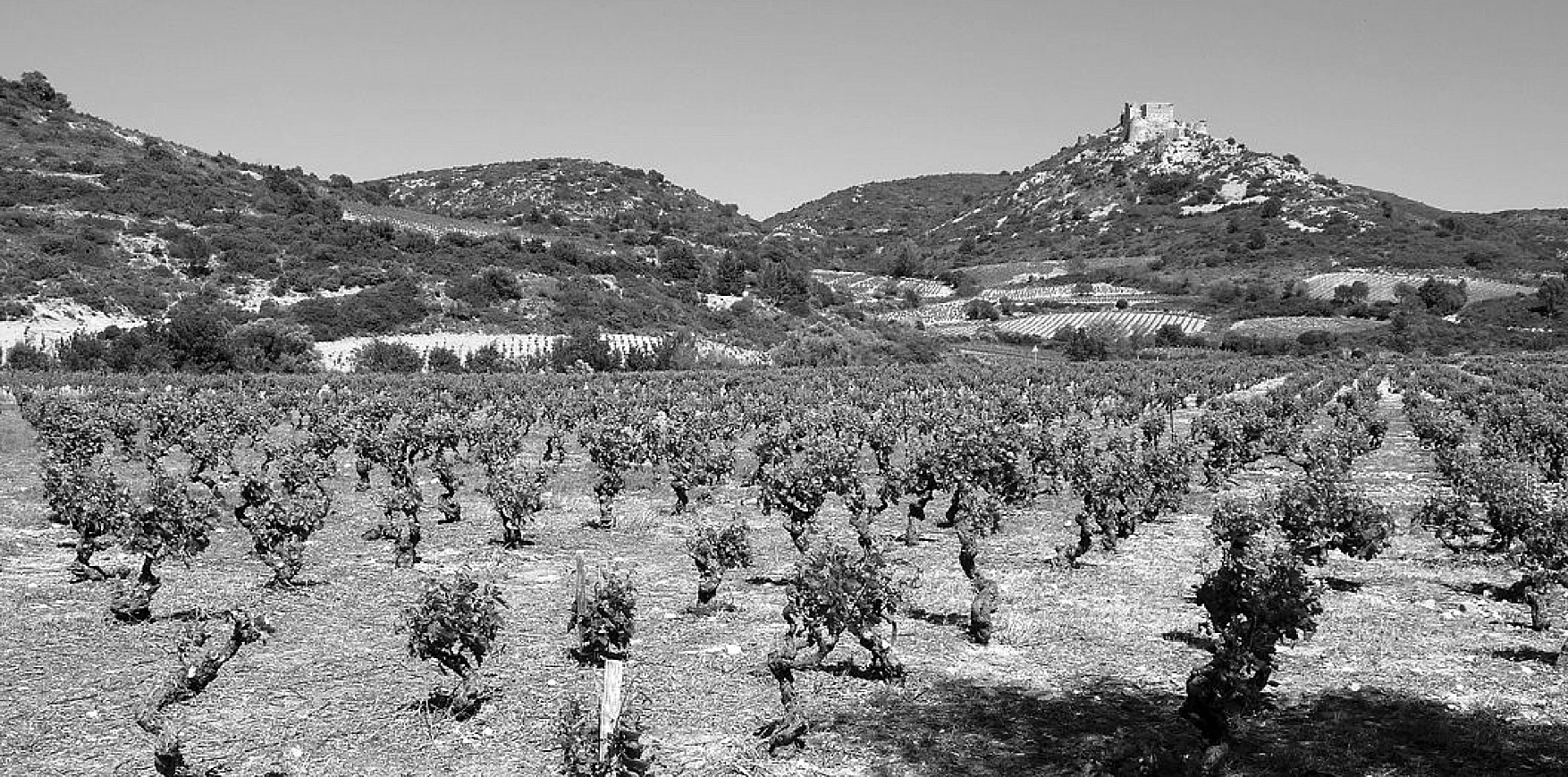
The P.S candidate isn’t a very forceful speaker and he doesn’t stand up. I can’t understand all of what he’s saying, apart from references to tourism and, particularly wine. I’d noticed around the Corbiéres region the same slogan was sprayed or chalked everywhere – on old farm buildings, isolated bus stops, on a road ‘BUVEZ VIN FRANCAIS“. This, apparently was a response to the importation of Algerian wine. The P.S candidate ended by saying he and his Party had full support for the French wine growers, and that the P.S. support was reliable, a curious word to use, I thought. Everyone had been listening attentively, and they clapped. During his speech I’d noticed, when making a point, he turned to the seated fat man on the left of the Mayor, who in response would forcibly nod his head in agreement. And it is this man, who has a deep gruff voice, who unlike the P.S candidate stands up. He’s a real pro. His voice booms across every corner of the hall. He refers to sheets of papers that he has produced from an attache case, waving this one and that one in the air, written proof, he claims, that you cannot ever put your trust in a Gaullist, never ever would be able to trust promises made by any Gaullist government, by the Gaullist Party. He shouts and harangues, and there are cheers from the audience. Having worked the audience up, he allows himself a smile of solidarity with them.
He’s been speaking longer than the P.S. candidate, who, soft spoken and soft featured is a curious candidate for the commune. But he’ll get in, probably, thanks to the rousing oratory of the P.S. heavy. The Mayor opens the discussion to the floor. One guy – obviously well known to the audience wants to ask a question. I say well known because there is a good humoured cheer and laughter as he stands up. He acknowledges their warmth with a grin and a theatrical bow. Turning back to the candidate sitting on the stage, he asks what he will do concretely once he’s in office. A brief reply by the candidate to the question, as the P.S. heavy shuffles back the papers he was waving into his attache case. And that’s it, the meeting’s over.
The men on the platform come down to the floor, mixing with the groups now, handshakes, laughter, chatter. Some starting moving off for the bar, to be followed by others. The meeting has lasted 90 minutes.
More grape picking tomorrow for me and everyone else. Outside in the warm deep dark night the cicadas crackle and croak. Buvez Vin Français. Buvez Corbières AOC.
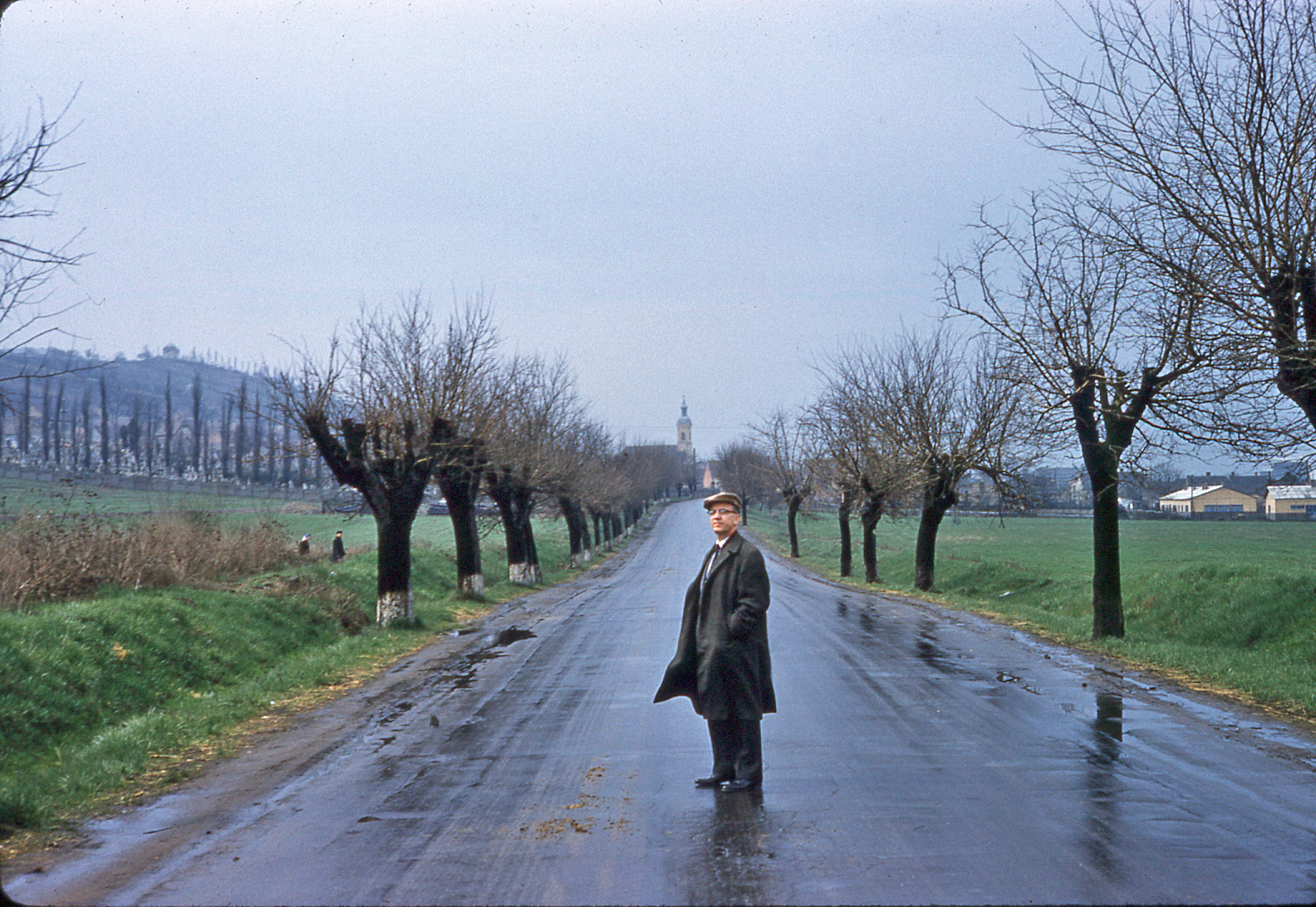
US Doc in Eastern Bloc. 3: Hungary 1959 – 1960
HUNGARY 1959 – 1960 in Kodachrome Colour

Palatinus Strand; Donány Street Synagogue; National Institute of Motor Therapy; Dr. Peto András.. beyond Budapest.. and sinister trucks.



Now on Pete Grafton/You Tube
US Doc in Eastern Bloc
1. Polska 1958, kolorowe zdjecia/Poland 1958, colour photos
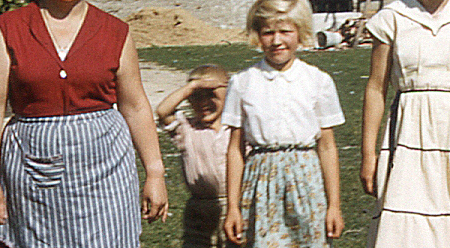
Kodachrome photos taken by a US Orthopeadic Doctor in Poland, 1958

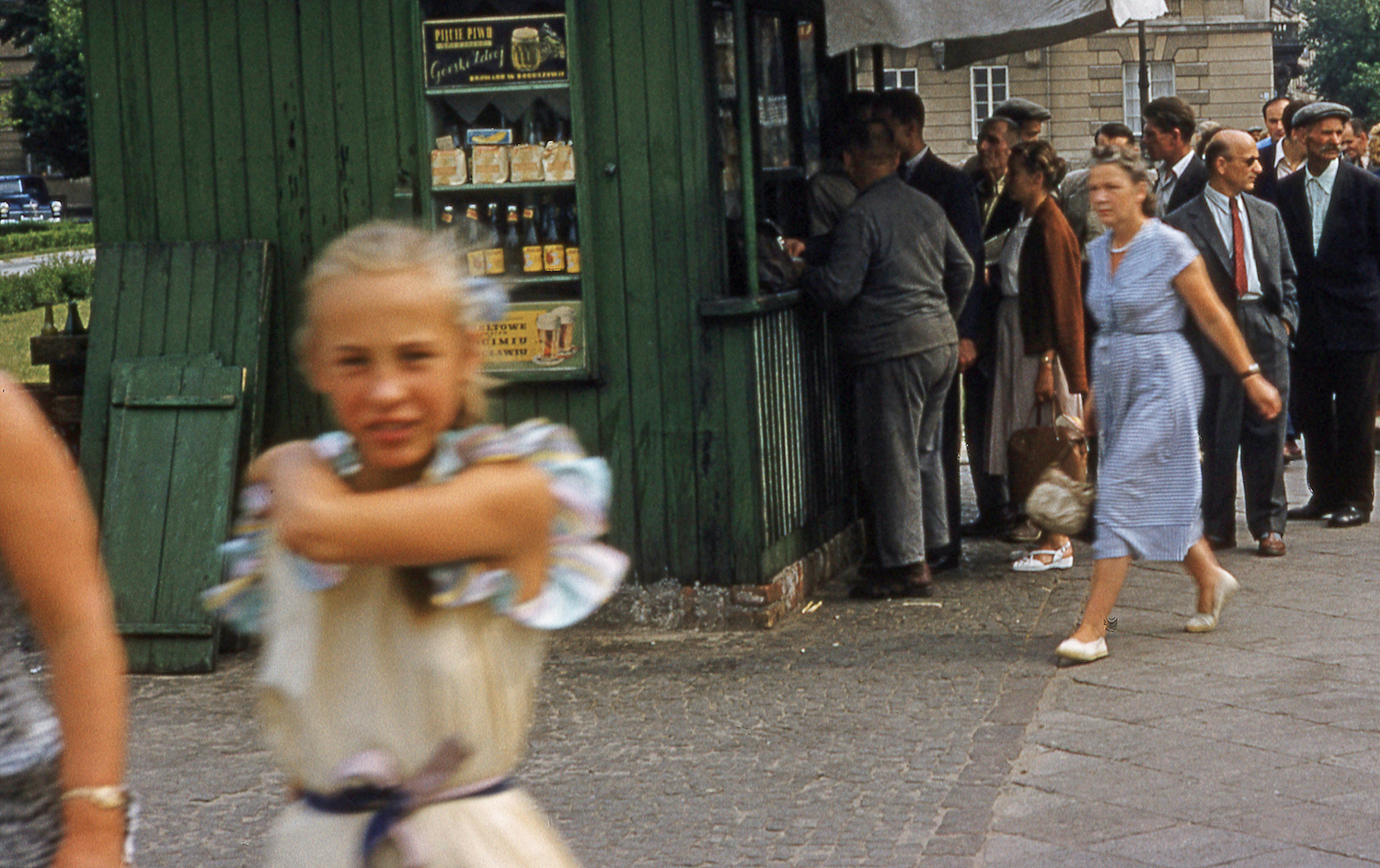
Now on Pete Grafton/You Tube
Click below
I N T E R MISSION
I N T E R MISSION

Praha, 1959

Budapest, 1959
US Doc in Eastern Bloc is a forthcoming 4 part series of photo videos of a US doctor travelling within the Eastern Bloc 1958 – 1960 His speciality was Orthopedics, and he may have been attached to the World Health Organisation in Geneva. The series starts mid-January 2022.
Click below for You Tube link
Hahn Hunsrück Heimat 2009
HAHN HUNSRÜCK HEIMAT 2009

HAHN: a village in the Hunsruck – HUNSRUCK, where German film-maker Edgar Reitz set his epic film series, spanning from 1918 to post re-unification of Germany in 1990.
HEIMAT – Home.
HAHN also was an important USAAF/NATO base. By 2009, with the changing political situation, it was almost unused, except for occasional NATO exercises.
HAHN is 117 km (73 miles) from Frankfurt. In 2009 RyanAir were flying a small schedule of flights from the UK to HAHN, a destination they called Franfurt Hahn.
As a military airbase it featured in the post German re-unification segment of Edgar Reitz’s HEIMAT
Waiting for a return flight to the UK I took photos.

Click below for the link to the Pete Grafton/You Tube link.
The Life of Things
The Life of Things

Now on Pete Grafton/You Tube
Click Below
Borders Town


Now on Pete Grafton/You Tube
Click Below
Jean Vigo, L’Atalante, Bassin de la Villette & Canal de St Denis
Jean Vigo, ‘L’Atalante, Bassin de la Villette & Canal de St Denis
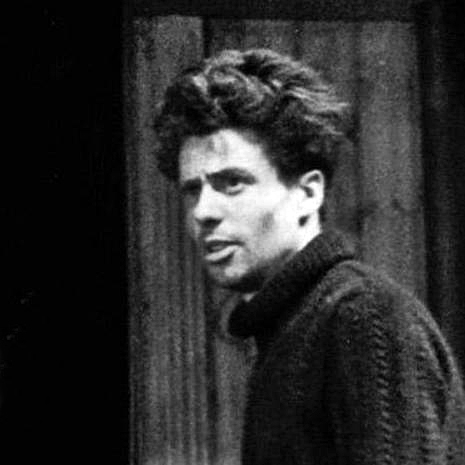
Jean Vigo 1905 – 1934
Homage to Jean Vigo poetic film director of two short films A propos de Nice, (1930) and the banned Zero de Conduite, (1932) and his final film, the feature film L’Atalante, mutilated on its 1934 release, the year he died from tuberculosis.

Poet and screenwriter Jacques Prevert near the Bassin de la Villette, 1938. He was an ‘Extra’ in Vigo’s Zero de Conduite. photo Robert Doisneau

Near the Bassin de la Vilette, 2008. photo Pete Grafton
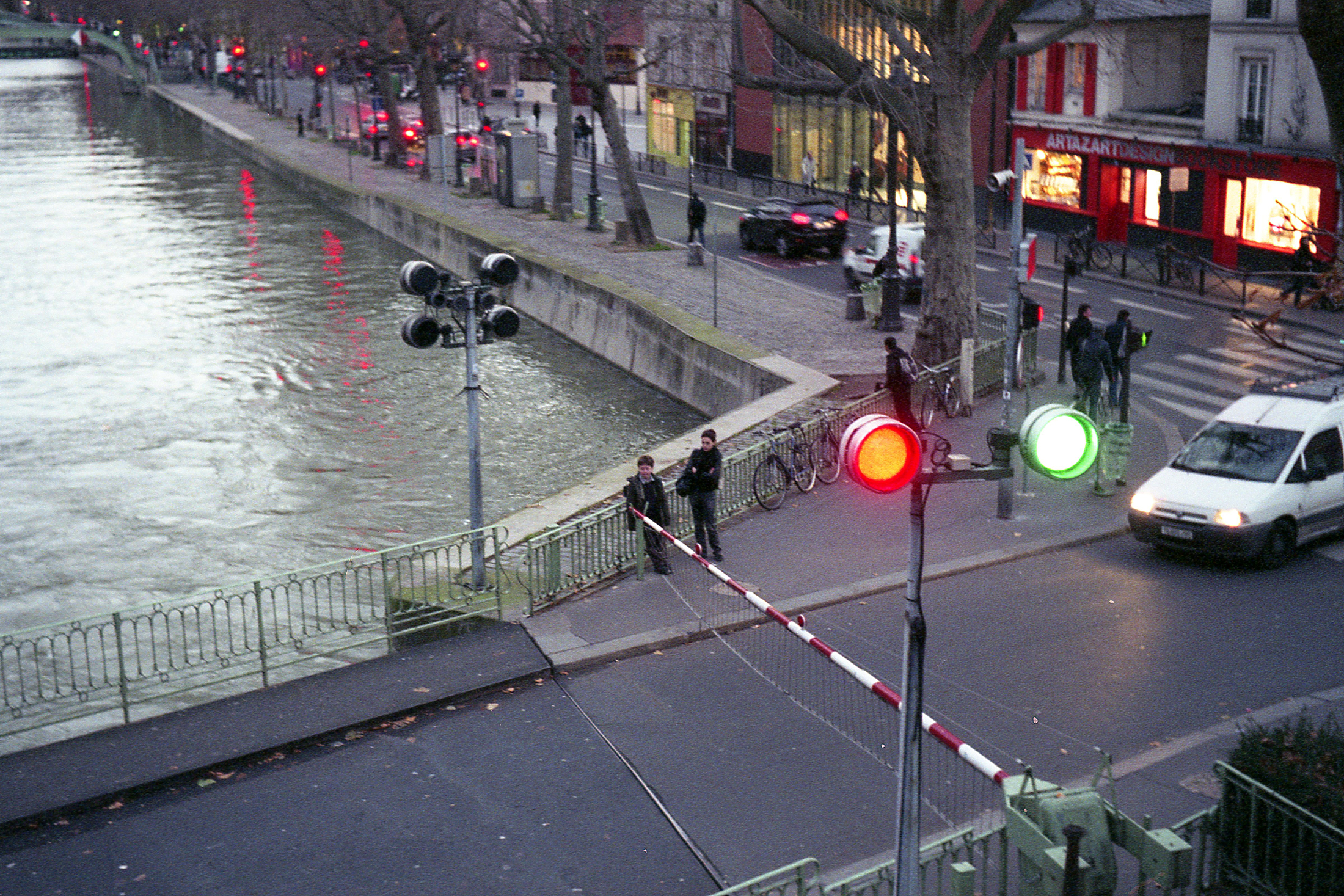
Now on Pete Grafton/You Tube
Egg and Sperm Race: Someone Else, Not Me
Egg and Sperm Race: Someone Else Not Me

The Extra-ordinary lottery of who we are born to, in what part of Earth, in what century, or if we are born at all


Now on Pete Grafton/You Tube
Dirty White Boy – Soho Photos
Dirty White Boy – Soho Photos


Dirty White Boy – Soho Photos now on Pete Grafton/You Tube
Click on Link
Fernandel à Berne
Fernandel à Berne

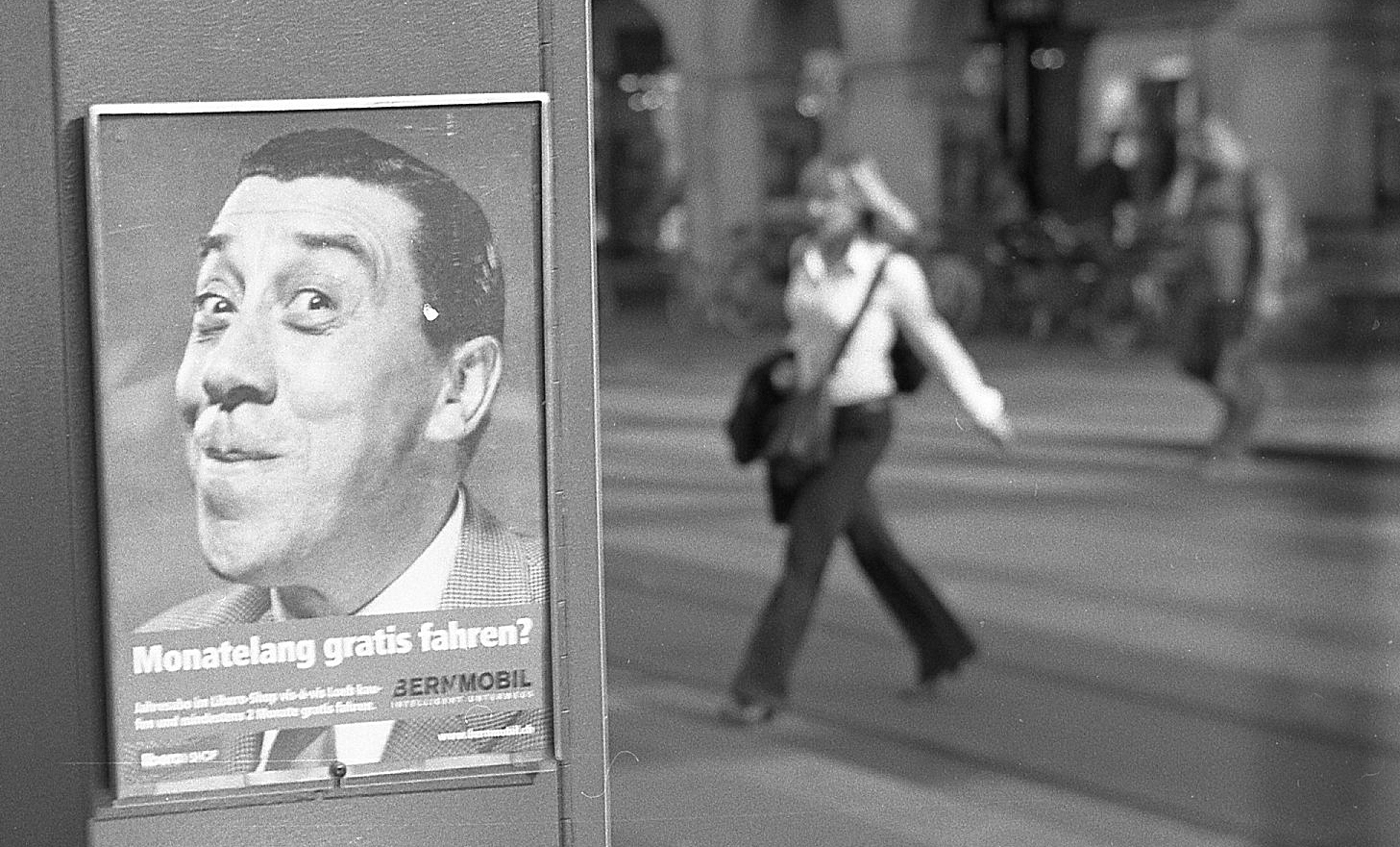
Now on Pete Grafton/You Tube
It Came in the Night
It Came in the Night
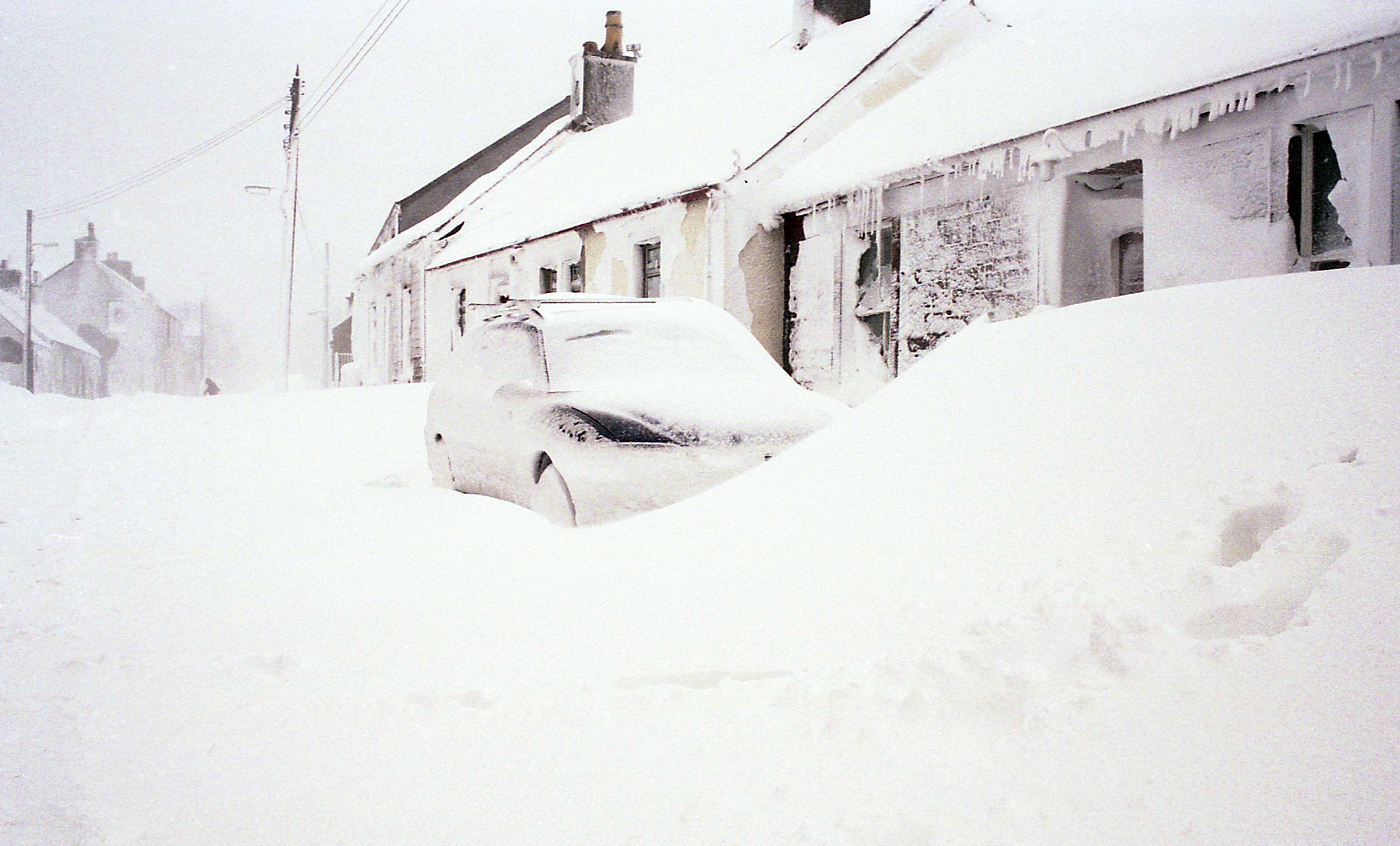

A Village Snowed In
Wear a Scarf when Watching
Now on Pete GraftonYou Tube
Marriage Italian Style (Bologna)
Marriage Italian Style (Bologna)


Now on Pete Grafton/You Tube
Can Cannes: Dreans/Reality
Can Cannes: Dreams/Reality

Now on Pete Grafton/You Tube

Sheringham by the Sea, 1903
Sheringham by the Sea, 1903
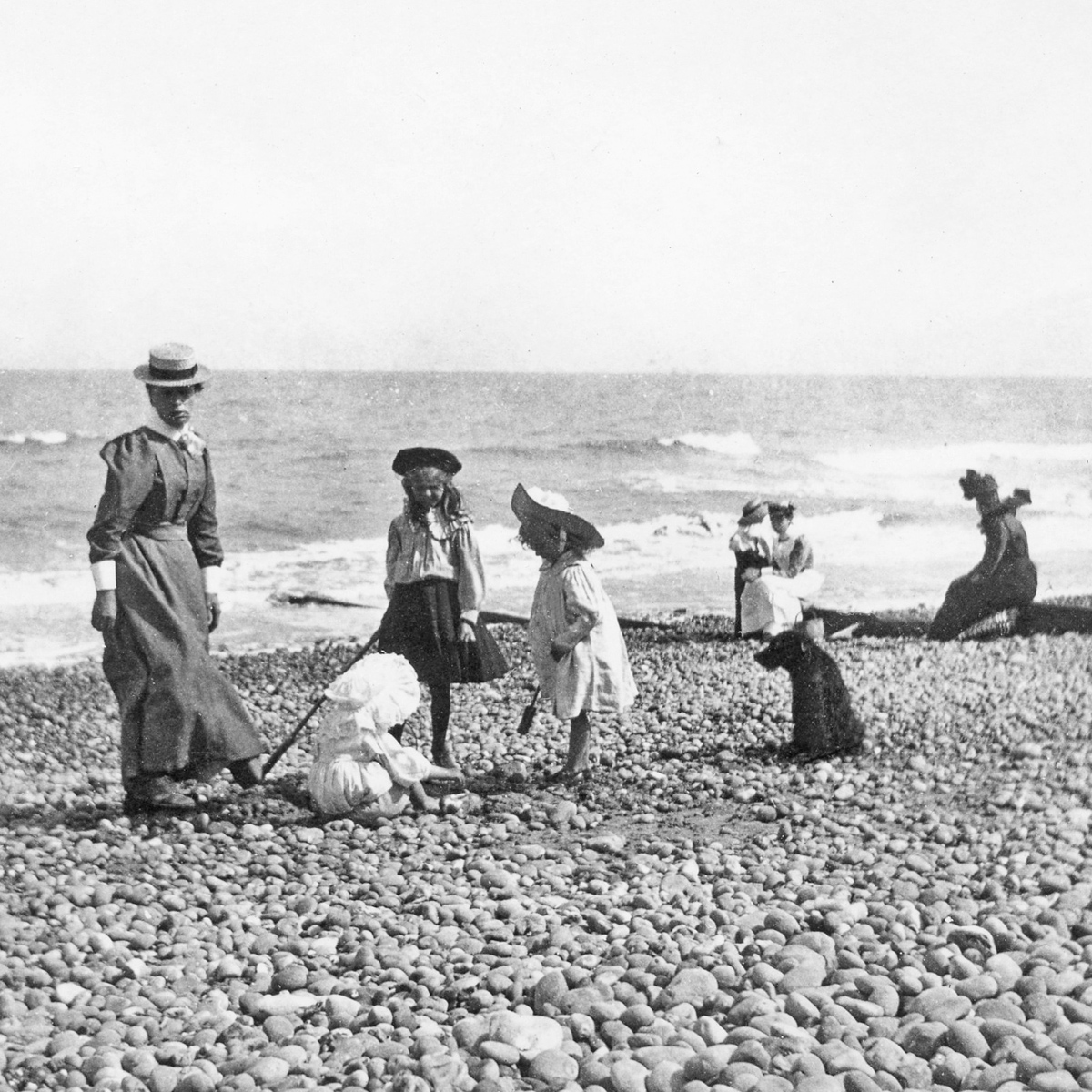

Now on You Tube. Click Below.
Heimatland 1938 (& Mittel-Schreiberhau/Szklarska Poreba)
Heimatland 1938 (& Mittel-Schreiberhau/Szklarska Poreba)


Now on You Tube
Nights on the Street
Nights on the Street
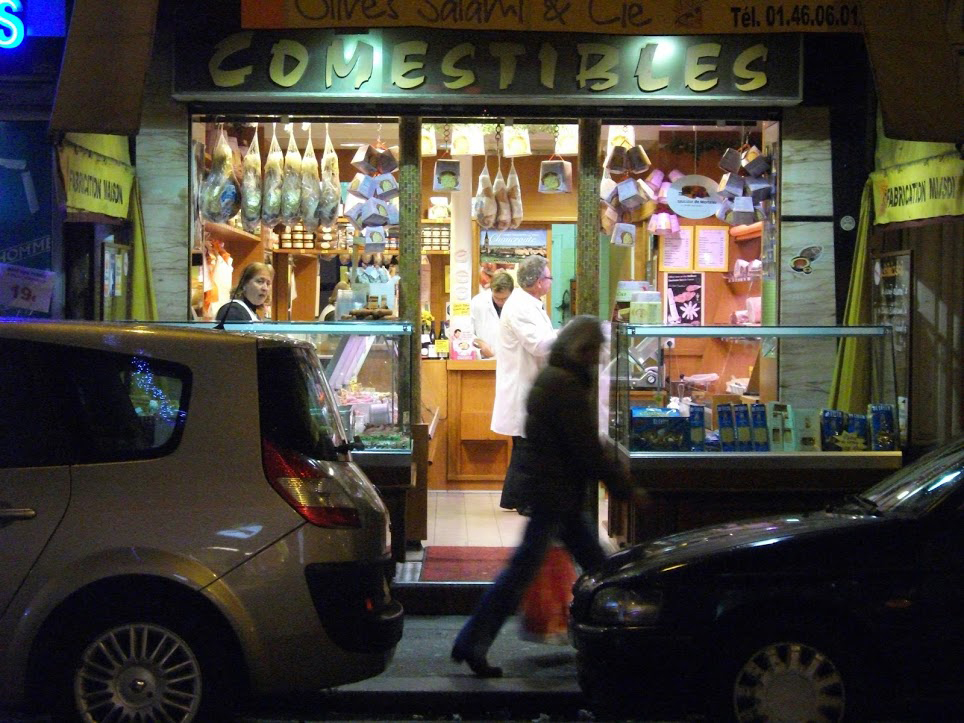
Now on Pete Grafton/You Tube.
Click Below

